Jan 6
2026
What’s Next for AI in Higher Education: 5 Strategic Shifts to Watch in 2026
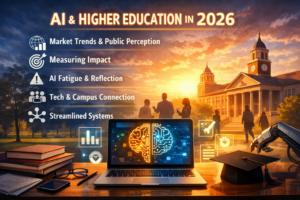 Artificial intelligence is no longer an emerging topic in higher education — it’s a core operational and pedagogical concern for campuses across the country. A new Inside Higher Ed analysis outlines five key ways AI will continue to reshape colleges and universities in 2026, offering a useful lens for IT leaders, academic technologists, and digital strategy teams.
- The Future of AI Depends on the Tech Market and Public Perception
AI’s trajectory in higher education isn’t defined only by what happens within campuses — it hinges on broader societal attitudes and the health of the AI sector itself. If the AI market softens or faces high-profile setbacks, institutional momentum around new tools and investments could slow. Conversely, continued innovation and adoption could solidify AI as a central pillar of academic infrastructure.
This also ties directly to how potential students and employers perceive the value of traditional degrees versus AI-driven learning pathways — a conversation that will intensify throughout 2026.
- Scaling AI Initiatives Means Measuring Impact
Institutions have moved past siloed pilots of AI tools. Next, they’re looking to scale strategic deployments — from campuswide AI literacy initiatives to enterprise-level services — while measuring outcomes. Leaders are increasingly asking:
- How do we evaluate the ROI of AI tools?
- What metrics matter most — learning gains, retention, operational efficiencies?
This shift from experimentation to strategic planning and evaluation marks a maturation of AI use in higher education.
- A Period of AI Disillusionment May Be Ahead
Not all momentum will be linear. Some educators and students are already expressing fatigue or skepticism about AI’s place in the classroom. Ongoing use exposes limitations — whether ethical, pedagogical, or technological — and stimulates reflection about why we use these tools and what we hope they’ll achieve.
Rather than rejecting AI entirely, this phase could help campuses deepen critical engagement with both technology and core academic values.
- Building Stronger Connections Between Tech and Campus Communities
AI adoption isn’t just about tools — it’s about people. Effective use in 2026 will depend on:
- IT and ed-tech leaders becoming communicators and trainers
- Faculty and staff empowered to integrate AI responsibly
- Students equipped with the skills to use and critique AI
This involves strengthening governance, trust, and shared decision-making across institutional units — not just installing new software.
- Reducing Fragmentation to Boost Efficiency
One of the most tangible promises of AI lies in connecting systems that historically don’t “talk” to one another: advising, enrollment, financial aid, billing, LMS data and more. AI-driven orchestration and automation could:
- Eliminate redundant processes
- Provide unified insights for administrators and advisors
- Improve student experiences with smoother workflows
Rather than layering new platforms on top of old ones, institutions are looking to intelligently weave existing systems together.
What This Means for IT Leaders
For technology professionals in higher education, these predictions reinforce a few clear priorities for 2026:
- AI governance and measurement are as important as tool selection.
- Human-centered support and training will determine whether AI helps or hinders outcomes.
- Operational integration of AI must be paired with transparency, ethics, and alignment to institutional missions.
In other words: AI isn’t just a technical challenge — it’s a strategic transformation. And campuses that treat it as such will be better positioned to deliver value for students, faculty, and the institution as a whole.